I hope this fits the criteria of the assignment!
Anyway, the source material I'm referring to is an article from the Asian Economic News website, published August 27 2001: "China to learn about Minamata mercury poisoning".
As a result of China's rapid industrialisation and economic growth, they too are repeating what has happened in numerous other regions which have gone through such a rapid change, namely, allowing environmental issues to take a backseat to development. Subsequently, many parts of China are having to deal with mercury and other pollutants being released into the environment at a dangerous rate.
In light of this, the city of Minamata and the Chinese city of Zhangjiagang, "designated as the first environment model city by the Chinese government", promoted an exchange in an attempt to share information on environmental issues, and according to the article, the city of Minamata intends to further this plan in an attempt to help other countries deal with similar poisonings.
Unfortunately I haven't looked much further into the issue to see what resulted of this, or whether these exchanges have spread further across the world, but if there were few good things to come of the Minamata poisoning then this would certainly be one of them. "The mercury poisoning occurred at the height of Japan's economic boom. We would like to tell China not to make that mistake," a Minamata official said.
Friday, July 3, 2009

Thursday, June 18, 2009
So bizarre you couldn't make it up
Came across this at The Japan Times website the other day:
Congratulations on setting your gender back 50 years, Miss Fujioka.
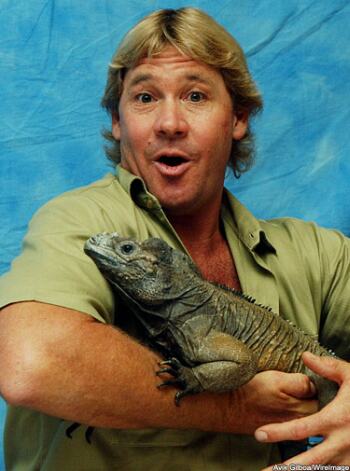
I'm not sure how the wider Japanese population feels about something such as this. There's certainly no denying that Japan pop culture is a source of soft power and a cultural asset, but to me it's still about as cringe-worthy as Crocodile Dundee, Steve Irwin or Ken Done paintings being cultural ambassadors for Australia.
'Cute ambassadors' roam globe to promote Japan's pop culture
Three female "ambassadors of cute" appointed by the Foreign Ministry have started traveling abroad to introduce Japanese pop culture to young people overseas.
One of the "kawaii ambassadors," Shizuka Fujioka, the "magician clothing coordinator" known for her school uniform outfits, took part in an event in Thailand in March. The other two will hit Paris in July.
[...]
"I think it will be in Japan's national interest if there is at least one person in the host country who thinks I'm pretty," [Fujioka] said.
(source)
Congratulations on setting your gender back 50 years, Miss Fujioka.
I'm not sure how the wider Japanese population feels about something such as this. There's certainly no denying that Japan pop culture is a source of soft power and a cultural asset, but to me it's still about as cringe-worthy as Crocodile Dundee, Steve Irwin or Ken Done paintings being cultural ambassadors for Australia.
Wednesday, June 10, 2009
「諸君の中に一人でも俺と一緒に立つ奴はいないのか。」
In light of some recent discussion concerning authors and stories, I felt it was apt to bring up a particular topic which I was originally going to mention in my post about Constitution Day and controversial symbolism - Yukio Mishima.
I'm certain that most people in Japan of at least a high school graduate age are aware of Yukio Mishima, even if they aren't familiar with his work. It's difficult to give a nutshell summary of his life, but as briefly as I can, he was a Japanese author born in 1925 who had a childhood spread between being raised by his grandmother who rarely let him venture outside or participate in "boyish" activities, and his militaristic father who held a disdain for any sort of effeminate behaviour. Mishima falsified medical conditions to avoid being drafted to fight in WW2, and against his father's wishes, furthered his passion of writing into and beyond his teen years. He penned numerous novels, plays and short stories, and later in life developed an interest in bodybuilding, ultra-nationalism, and eventually formed his own private militia, the Tatenokai. On November 25, 1975, Mishima and members of the Tatenokai attempted to stage a coup d'etat at a Self Defence Forces base in Tokyo, aiming to reinstate the Emperor as the political power of Japan through an address on a balcony to the soldiers below. Upon its failure, Mishima retreated into the building, committed seppuku, and was beheaded by one of his followers.

First of all, I admit that I haven't even come close to reading a sizeable portion of his work, so extensive (and occasionally impenetrable) is his oeuvre. But whilst his novels tell genuinely captivating tales, I find the story of Mishima himself far more fascinating. The transformation from a timid, frail, and effeminate young man into a brutal, narcissistic nationalist with a fascination for death, combined with his not-so-closeted homosexuality, is rather unique. However, it seems he is often brushed off by many as simply being a "crazy man" or "a bit strange".
To me, Mishima is also one of many pieces in the puzzle of Japan's struggle to assert and identify itself in the postwar period. The bombings of Hiroshima and Nagasaki, comfort women, Nanjing, SCAP Occupation, Yasukuni Shrine, history revisionism, etc., all play into this issue (and is an enormously broad topic about which volumes can and have been written!). Unto this, Mishima seems to have been adopted by numerous right-wing groups in Japan as a sort of inspirational figurehead (have a look at this link) despite his contrasting belief that Emperor Hirohito should have taken responsibility for those who died during the war.
Now, having said all that and having made a huge segue into right-wing groups, one point I'd like to get across is that I can't stand these twits. Not because of their politics or radical ideologies, but mainly because of the noise pollution they create. I'm not quite sure how the police manage to turn a blind eye (or rather, a deaf ear) to such a disturbance, as these groups would undoubtedly have their vehicles and equipment confiscated if they attempted to drive around blaring slogans and music in other countries. On a similar level, the police seem completely uninterested in reining in various bousouzoku bike gangs creating all kinds of noise at 4 o'clock in the morning, but appear quite willing to stop foreigners on their bicycles for no apparent reason...
Right, it's about time I went to bed!
I'm certain that most people in Japan of at least a high school graduate age are aware of Yukio Mishima, even if they aren't familiar with his work. It's difficult to give a nutshell summary of his life, but as briefly as I can, he was a Japanese author born in 1925 who had a childhood spread between being raised by his grandmother who rarely let him venture outside or participate in "boyish" activities, and his militaristic father who held a disdain for any sort of effeminate behaviour. Mishima falsified medical conditions to avoid being drafted to fight in WW2, and against his father's wishes, furthered his passion of writing into and beyond his teen years. He penned numerous novels, plays and short stories, and later in life developed an interest in bodybuilding, ultra-nationalism, and eventually formed his own private militia, the Tatenokai. On November 25, 1975, Mishima and members of the Tatenokai attempted to stage a coup d'etat at a Self Defence Forces base in Tokyo, aiming to reinstate the Emperor as the political power of Japan through an address on a balcony to the soldiers below. Upon its failure, Mishima retreated into the building, committed seppuku, and was beheaded by one of his followers.

First of all, I admit that I haven't even come close to reading a sizeable portion of his work, so extensive (and occasionally impenetrable) is his oeuvre. But whilst his novels tell genuinely captivating tales, I find the story of Mishima himself far more fascinating. The transformation from a timid, frail, and effeminate young man into a brutal, narcissistic nationalist with a fascination for death, combined with his not-so-closeted homosexuality, is rather unique. However, it seems he is often brushed off by many as simply being a "crazy man" or "a bit strange".
To me, Mishima is also one of many pieces in the puzzle of Japan's struggle to assert and identify itself in the postwar period. The bombings of Hiroshima and Nagasaki, comfort women, Nanjing, SCAP Occupation, Yasukuni Shrine, history revisionism, etc., all play into this issue (and is an enormously broad topic about which volumes can and have been written!). Unto this, Mishima seems to have been adopted by numerous right-wing groups in Japan as a sort of inspirational figurehead (have a look at this link) despite his contrasting belief that Emperor Hirohito should have taken responsibility for those who died during the war.
Now, having said all that and having made a huge segue into right-wing groups, one point I'd like to get across is that I can't stand these twits. Not because of their politics or radical ideologies, but mainly because of the noise pollution they create. I'm not quite sure how the police manage to turn a blind eye (or rather, a deaf ear) to such a disturbance, as these groups would undoubtedly have their vehicles and equipment confiscated if they attempted to drive around blaring slogans and music in other countries. On a similar level, the police seem completely uninterested in reining in various bousouzoku bike gangs creating all kinds of noise at 4 o'clock in the morning, but appear quite willing to stop foreigners on their bicycles for no apparent reason...
Right, it's about time I went to bed!
Wednesday, June 3, 2009
Sexy sumo carwash
Not for the purposes of social commentary or serious discussion or anything of the sort... just for a laugh!
Wednesday, May 27, 2009
Research assignment
Depending on the nature of this research assignment I may end up choosing another quote, as this one is a bit unusual, or perhaps completely inapplicable! The quote comes from a novel titled Love and Death, written in 1939 by the Japanese writer Saneatsu Mushanokōji. I haven't actually read the novel itself, but instead found the quote in Misunderstanding: Europe vs Japan (Chuokoron-sha, Tokyo, 1982, p.135) by Endymion Wilkinson. The following is written from the point of view of the story's protagonist, Muraoka, who writes home from Paris:
Wherever one goes one sees only Occidentals... somehow I have the feeling that we are looked down upon... A solitary Japanese among a group of Occidentals is hardly an imposing figure. This is due to a large extent to our not being suited to Western style clothes, but even if we try to make something of the color of our skin and our physique, we still have very little to boast about. Nevertheless, I am confident that from the standpoint of spiritual power and intelligence we are not in the least inferior. The majority of Europeans love pleasure too much. Few of them have any faith in a future life. For the most part they live idly from day to day.Despite this being a work of fiction, Wilkinson asserts that it is reflective of the "popular sentiments" towards Europeans held by the Japanese during the 1930s.
Friday, May 15, 2009
East vs West
Just a very brief post - came across a website today with a series of simple diagrams contrasting the (supposed) ways in which Westerners and Asians will approach particular situations:
http://buburuza.net/2008/12/culture-east-vs-west/
As it mentions, the person who created these images is a person who was born in China and has studied in Germany. Whilst I feel a lot of the red images are certainly representative of life in China, I don't agree that it "applies to all Asians" as the website states. Similarly, I don't believe that all the blue images are true of all Western people.
However, it's still an amusing concept and makes you think about these things a little.
http://buburuza.net/2008/12/culture-east-vs-west/
As it mentions, the person who created these images is a person who was born in China and has studied in Germany. Whilst I feel a lot of the red images are certainly representative of life in China, I don't agree that it "applies to all Asians" as the website states. Similarly, I don't believe that all the blue images are true of all Western people.
However, it's still an amusing concept and makes you think about these things a little.
Sunday, May 3, 2009
Symbols
As it's Constitution Day in Japan today I was going to write some vague and rambling post about nationalism in Japan, but I might leave that for another time. Instead, I'd like to post up this picture which I took about a month ago:

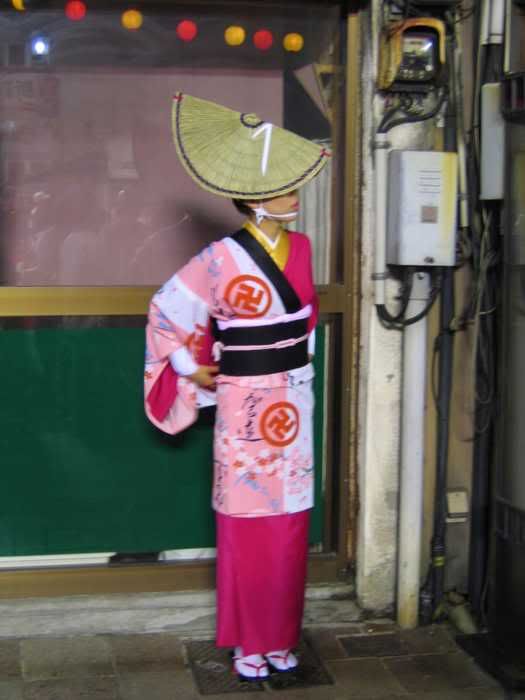
Due to the prevalence of Buddhism in Japan it's not at all uncommon to see the swastika symbol in various forms, most typically an omote-manji (anti-clockwise swastika) on temple decor or on traditional clothing (dancer from Awa Odori), and Western people in general seem to be aware of such a usage. Although for many foreigners here it's still a mild surprise to see an angled ura-manji (clockwise swastika) such as the one above adorning people's clothing, motorbikes, accessories, etc., identical to that used by the Nazi Party of WW2 Germany. Clearly there isn't the same stigma attached to this particular type of swastika in Japan as there is in the West; if this student shown above were to walk around in particular countries he would no doubt face threats and intimidation, and in Germany and Austria, would be arrested for doing so.
So, I guess I'm asking anyone reading this as to whether it's acceptable for the youth of Japan to use the angled ura-manji as a fashion statement? Or whether it shows a sort of ignorance or contempt for historical events?
Although having said all that, due to the fact that the swastika (and numerous other noble and powerful symbols dating back thousands of years) were misappropriated by the Nazis there is a sweet irony of sorts in seeing something like this happen. Admittedly I am also perhaps guilty of trivialising such symbols due to having clothing/accessories/CDs/paraphernalia featuring the Iron Cross, Nordic runes, the Soviet hammer and sickle, and even the symbol of the DPRK's Korean Workers' Party. However, I certainly wouldn't bring my ushanka nor my USSR flag to Japan!
Perhaps it just comes down to a relativism of sorts - Australia is/was quite removed from communism and its effects (aside from the nonsensical "fear of communism" business in the 40s and 50s) yet has a relatively high population of people who were adversely affected by Nazi Germany, hence the strongly negative reactions to a symbol such as a swastika. I'd be happy to be corrected on this if I'm wrong, but I believe Japan could be considered to have the inverse of this situation.
I was also going to make mention of the Rising Sun Flag in contemporary Japan and the West, but I think this post has gone on for long enough. :)
Due to the prevalence of Buddhism in Japan it's not at all uncommon to see the swastika symbol in various forms, most typically an omote-manji (anti-clockwise swastika) on temple decor or on traditional clothing (dancer from Awa Odori), and Western people in general seem to be aware of such a usage. Although for many foreigners here it's still a mild surprise to see an angled ura-manji (clockwise swastika) such as the one above adorning people's clothing, motorbikes, accessories, etc., identical to that used by the Nazi Party of WW2 Germany. Clearly there isn't the same stigma attached to this particular type of swastika in Japan as there is in the West; if this student shown above were to walk around in particular countries he would no doubt face threats and intimidation, and in Germany and Austria, would be arrested for doing so.
So, I guess I'm asking anyone reading this as to whether it's acceptable for the youth of Japan to use the angled ura-manji as a fashion statement? Or whether it shows a sort of ignorance or contempt for historical events?
Although having said all that, due to the fact that the swastika (and numerous other noble and powerful symbols dating back thousands of years) were misappropriated by the Nazis there is a sweet irony of sorts in seeing something like this happen. Admittedly I am also perhaps guilty of trivialising such symbols due to having clothing/accessories/CDs/paraphernalia featuring the Iron Cross, Nordic runes, the Soviet hammer and sickle, and even the symbol of the DPRK's Korean Workers' Party. However, I certainly wouldn't bring my ushanka nor my USSR flag to Japan!
Perhaps it just comes down to a relativism of sorts - Australia is/was quite removed from communism and its effects (aside from the nonsensical "fear of communism" business in the 40s and 50s) yet has a relatively high population of people who were adversely affected by Nazi Germany, hence the strongly negative reactions to a symbol such as a swastika. I'd be happy to be corrected on this if I'm wrong, but I believe Japan could be considered to have the inverse of this situation.
I was also going to make mention of the Rising Sun Flag in contemporary Japan and the West, but I think this post has gone on for long enough. :)
Subscribe to:
Posts (Atom)